




ABOUT
Stone sculpture is often encountered as an accomplished fact. In the gallery, it appears stable, resolved, and removed from time: a finished form whose material permanence seems to eclipse the labour that produced it. The noise of cutting, the density of stone dust, the gradual depletion of tools, and the physical demands placed on the sculptor’s body rarely remain visible once a work enters exhibition space.
In *Rolling the Boulder-Searching for Sisyphus*, Lin Kuan-Chun redirects attention to precisely these overlooked conditions. Rather than presenting stone carving as a process that culminates in a perfected object, the exhibition foregrounds the slow, repetitive, and materially resistant work that makes sculpture possible. Grinding—usually understood as a technical step toward refinement—becomes the central activity of the practice. Stone is altered, but so are the tools that act upon it; dust accumulates as evidence of contact; and the body continually recalibrates its weight, force, and rhythm in response to the material.For Lin, sculpture is not simply a matter of shaping stone. It is an extended negotiation between body, tool, and matter.
From Image to Action
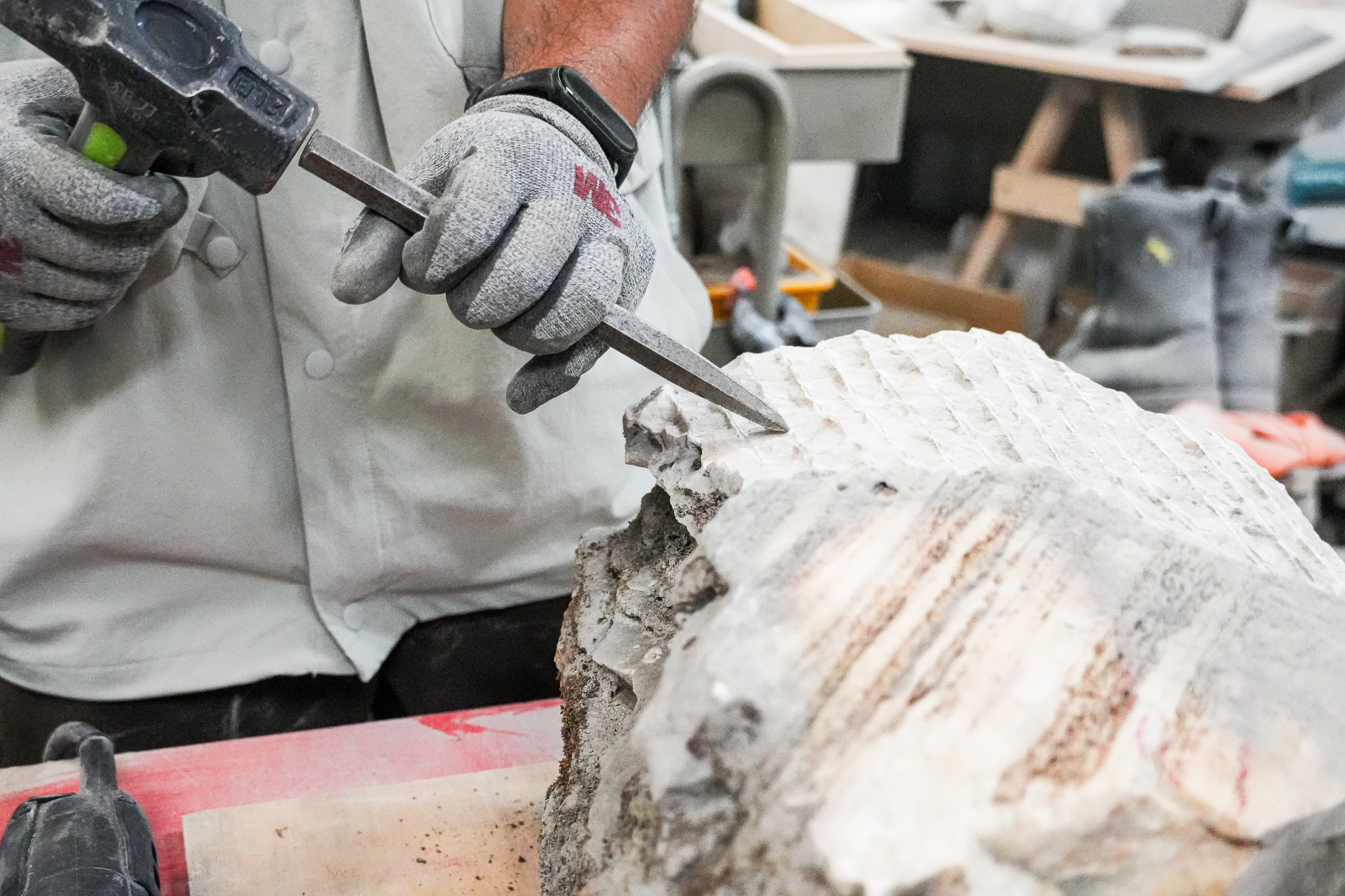
Lin’s relationship with stone developed during his studies in the Department of Sculpture at the National Taiwan University of Arts. Trained across metal, wood, clay, casting, and stone carving, he was drawn to the specific physicality of stone: its crystalline texture, its density, and the force that returns through the hand and arm when hammer meets chisel. His early works were often figurative, drawing on natural, biological, and animal forms. They reflected the technical and representational foundations of academic sculpture, but they also prompted a more fundamental question. What interested him increasingly was not only what a sculpture depicted, but how the act of making could itself become meaningful. An important influence came from his former professor, Wang Kuo-Hsien, who encouraged him not to resolve uncertainty too quickly. Rather than beginning with a fully formed concept, Lin learned to continue working and allow questions to emerge through the process of making. This has remained central to his practice: meaning does not precede material engagement; it develops through it.
After graduate school, the loss of institutional facilities and large-scale equipment imposed practical limits on his work. Working from home, he adapted to a smaller, quieter mode of production, carving by hand in a compact sandpit. These constraints became productive. Without the scale, machinery, and formal ambitions associated with conventional stone sculpture, Lin began to reconsider the medium at its most basic level: the body applies force, the tool moves, and the material responds.
When Tools Become Sculpture
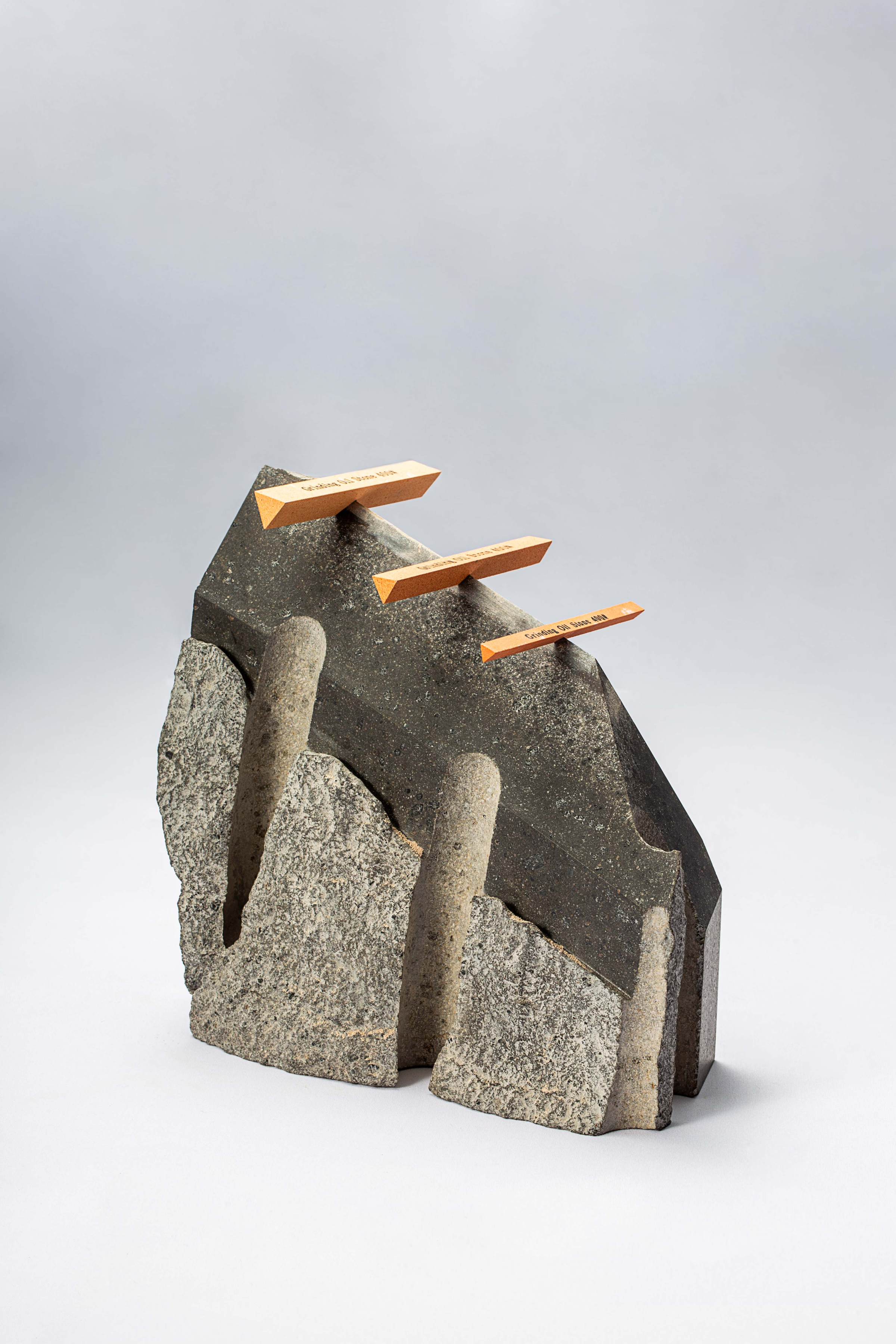
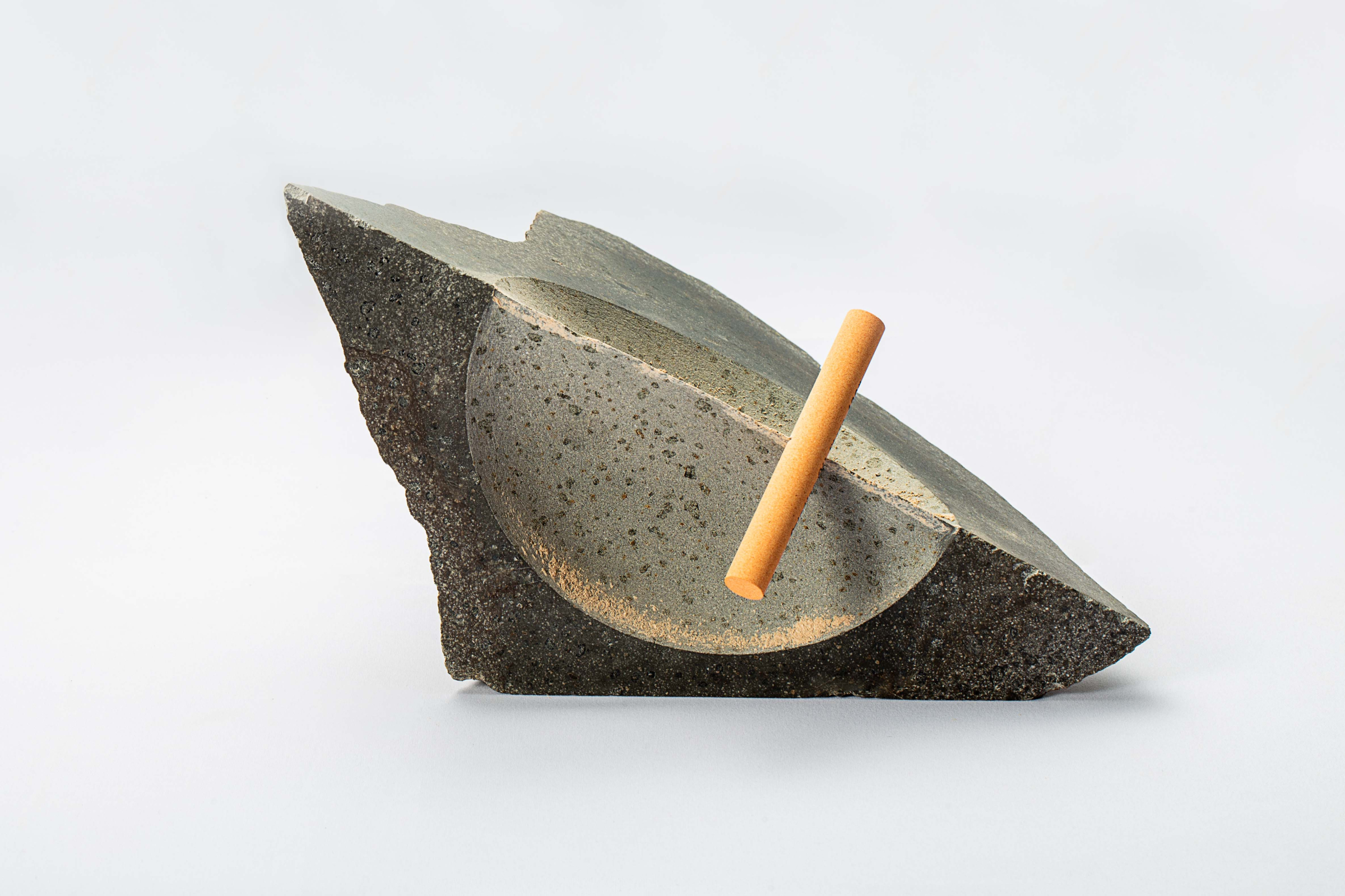
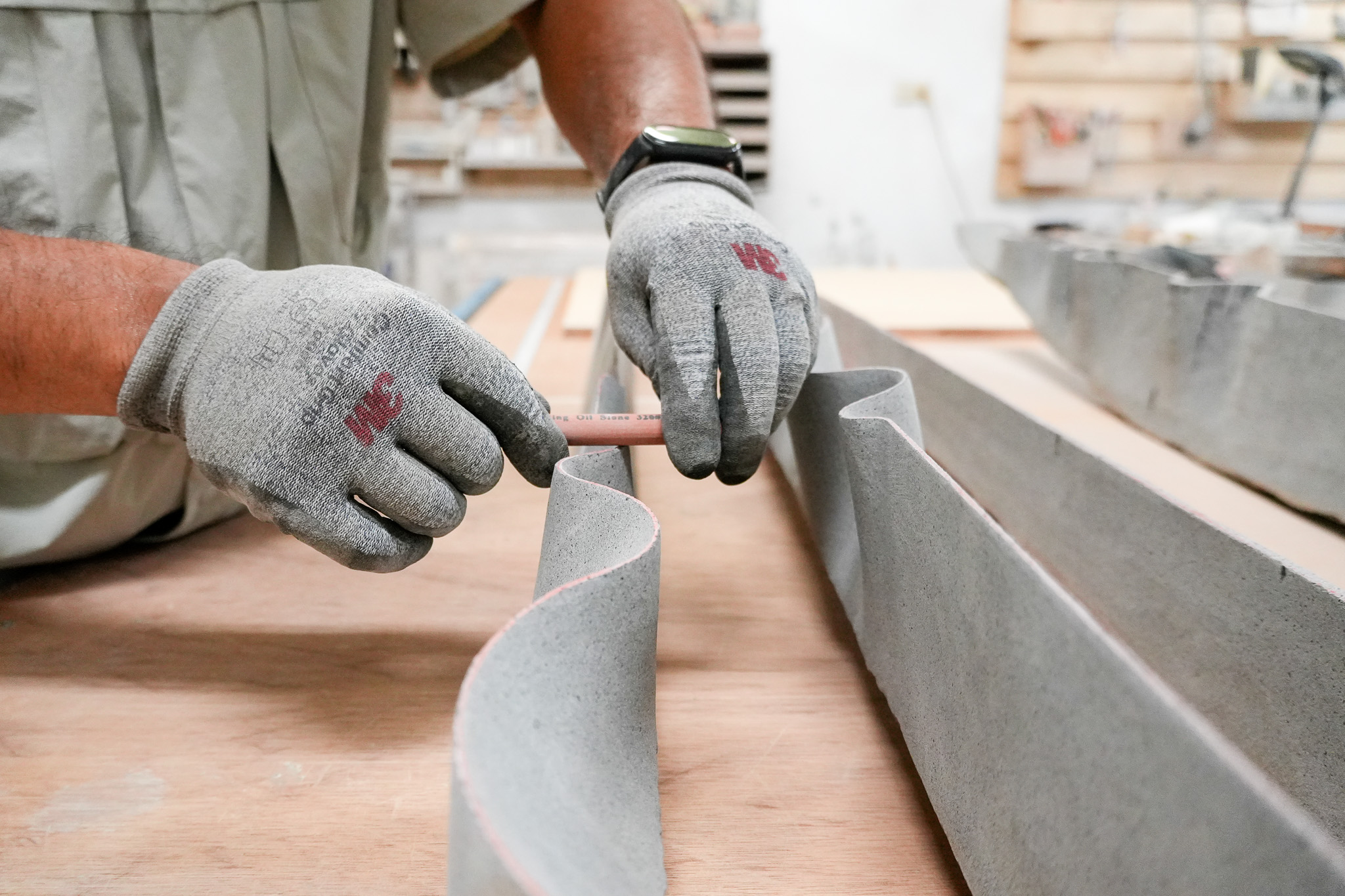
The works in *Rolling the Boulder-Searching for Sisyphus* retain the marks of their making. Cut edges, drilled holes, fractured surfaces, and rough crystalline textures remain visible. Lin resists the expectation that stone must be polished into a seamless finish; instead, he allows each block to retain something of its condition as raw material. Alongside the stone are industrial grinding rods and green abrasive sticks, commonly known as *qing bang*. These are standardised, mass-produced tools designed to wear away other surfaces. Their role is usually functional and temporary: they are consumed through use, then replaced. Lin shifts this hierarchy. Through repeated grinding, the abrasive tools are gradually reshaped by the very process they facilitate. Their surfaces wear down, grooves form, and their contours slowly adapt to the angles of the stone. Eventually, they may fit into a particular corner or edge, appearing to lock into place.
In these works, the stone is not the only material being sculpted. The tool is also cut, worn, and transformed. Sculpture emerges from a reciprocal process in which two materials alter one another. Ancient geological matter meets industrial consumable; permanence encounters replaceability. The resulting balance is often precarious. Some elements appear to rest on an edge, hold themselves in position through friction, or hover in a state that seems almost unstable. The works do not offer the reassuring solidity conventionally associated with stone sculpture. Instead, they produce a tension between weight and fragility, control and contingency.
Dust and the Visibility of Duration
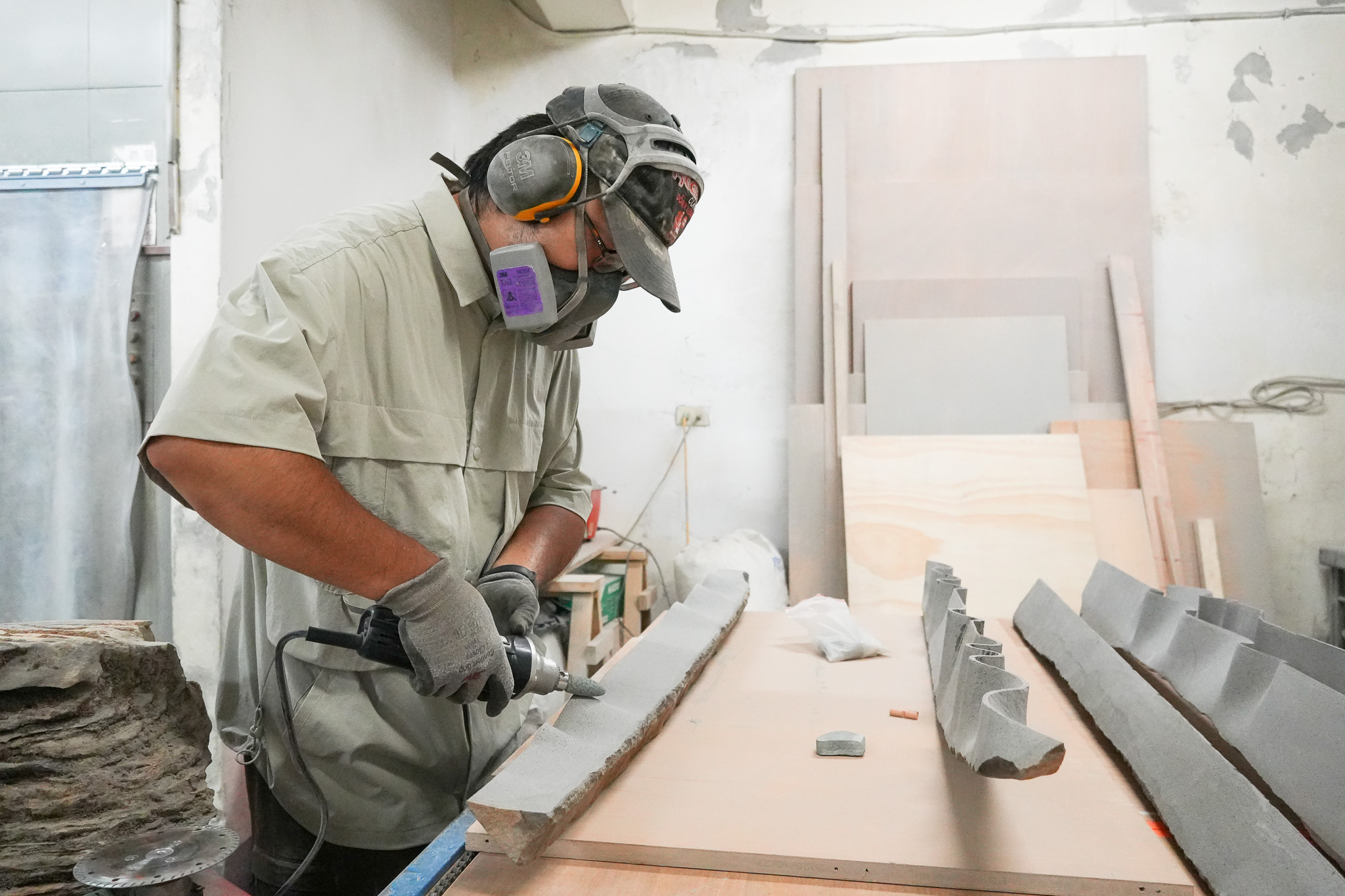
Grinding is an accumulative act of subtraction. Each movement removes only a minute amount of material, but over time those minute losses become visible as altered surfaces, reshaped tools, and layers of dust. For this exhibition, Lin completed part of the grinding process inside the gallery during installation. The dust produced by the work remains on the sculptures, plinths, and surrounding surfaces. It is not treated as residue to be cleaned away, but as a material record of the process itself.
Dust marks that something has happened, even if it cannot reveal every gesture that produced it. It is evidence of duration: a material remainder generated by friction, pressure, and loss. Video documentation within the exhibition further extends this temporal dimension, allowing visitors to witness the repetitive pace of grinding that static objects cannot fully convey. Unlike a dramatic cut or a decisive strike, grinding rarely produces immediate visual transformation. Its effects are almost imperceptible in any single moment. Only repetition makes change visible. In this sense, Lin’s works do not merely present a finished result; they contain the time that has passed through them.
The Body as a Site of Knowledge
Stone carving is inseparable from physical labour. Cutting, lifting, hammering, and grinding require sustained strength and concentration. They also expose the body to vibration, noise, fatigue, and injury. Having grown up in a sports-oriented family and maintained a long-term weight-training practice, Lin approaches this physical demand with particular awareness. He recognises a connection between the body in the gym and the body in the studio: both involve repetition, resistance, load, and muscular control. Yet their structures are very different. Exercise typically follows measured sets, defined goals, and planned intervals of rest. Studio labour does not always permit such boundaries. A task may continue until the body stiffens, concentration weakens, or sensation becomes dull.
This awareness led Lin to shift his attention away from the completed work and toward the body’s experience during production. He observes how a tool is held, where force originates, how posture changes, and how breathing affects movement. Grinding becomes less a means to an end than a slow form of bodily practice. Stone, in turn, determines the terms of that practice. Harder materials require concentrated force and patient repetition; softer marble responds differently, gradually losing sharpness and becoming rounded under sustained abrasion. Every mark on the work records both a material property and a bodily adjustment. The body is not a neutral instrument directing the tool. It is a sensing, measuring, and responsive presence within the work.
Sisyphus and the Meaning of Repetition
The title *Pushing Stone—In Search of Sisyphus* invokes the Greek figure condemned to push a boulder endlessly uphill, only to watch it roll back down. For Lin, Sisyphus provides a way to think about the cyclical nature of artistic labour. Stone sculpture demands space, equipment, materials, physical endurance, and financial resources. Completing one work does not bring the process to a final conclusion; it simply leads back to the beginning of another. There is no permanent arrival at the summit.
Albert Camus’s *The Myth of Sisyphus* does not offer an escape from this condition. Instead, it considers the possibility of meaning within the conscious acceptance of repetition. Lin does not romanticise the hardship of sculptural labour. Dust, noise, pain, and cost remain real conditions. Nor does repetition automatically become transcendent. Yet by making the process visible, he asks whether attention itself can transform one’s relation to necessary work. The question is not whether the stone can finally be conquered. It is how one continues to work with it.
The Exhibition as a Working Field
Comprising approximately eighteen sculptures and installations, the exhibition unfolds through varying scales and modes of display. Smaller works on plinths invite close attention to the precise relationships between stone and abrasive tool. Other works lean against or hang from walls, disrupting the expectation of sculpture as an autonomous, freestanding mass. Floor-based installations incorporate stacking, suspension, and heavy moving equipment, bringing the spatial logic of the workshop into the gallery. Natural light entering through the large windows of KCCA Chengde Gallery shifts across the works throughout the day. Stone crystals, abrasion marks, and dust appear differently as the light changes. Illumination is therefore not simply functional; it activates the work’s unstable surface and makes apparent that even apparently solid material is never visually fixed.
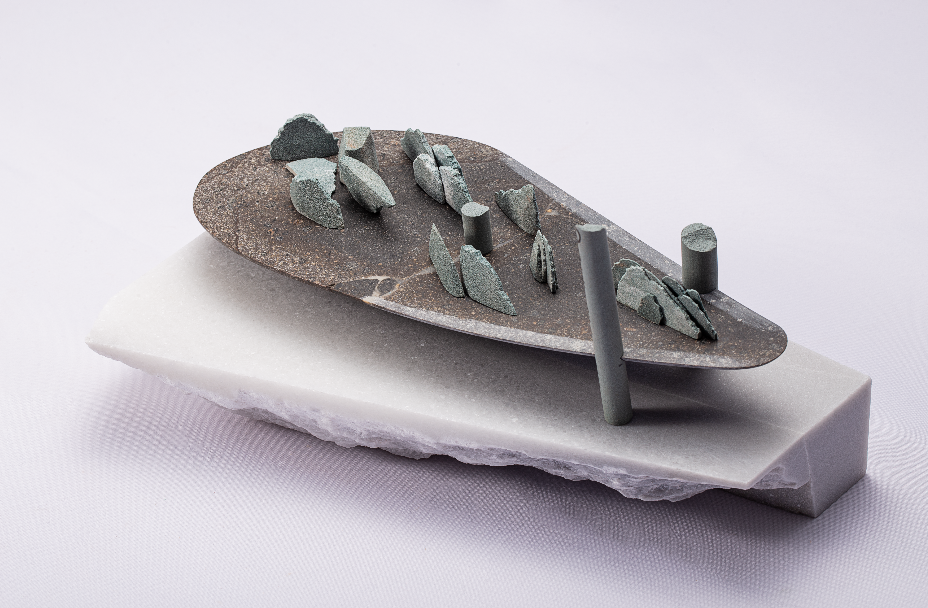
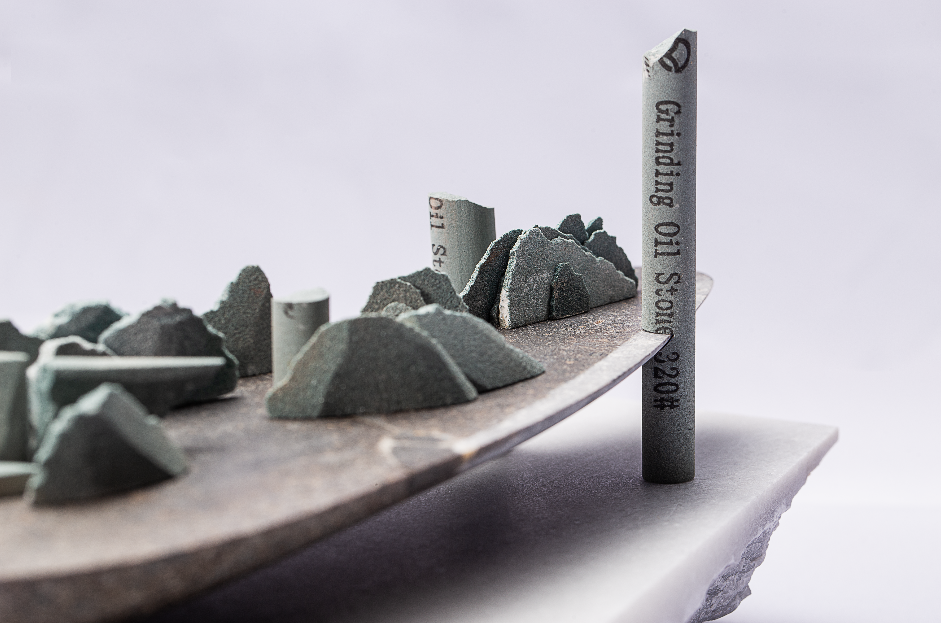
Balance After Grinding No. 8* offers a concentrated example of this approach. The work grew out of Lin’s early observation that worn green abrasive sticks, once depleted through use, began to develop irregular profiles resembling mountains or small landscapes. What had been a disposable tool acquired an unexpected formal presence. Reintroduced into sculptural compositions, these worn materials retain their industrial identity while becoming independent sculptural elements. They can stand alone or combine with stone in changing configurations. Their depletion is no longer concealed as evidence of use; it becomes the basis of form.
Rather than asking viewers to extract a single philosophical conclusion, Lin invites them to look differently at stone sculpture. To notice the worn tool, the settling dust, the pressure of a hand, and the persistence of a body working against resistance. *Pushing Stone—In Search of Sisyphus* does not celebrate the final victory of form over material. It keeps the process open.
Here, labour is not hidden behind the sculpture. It is where the sculpture begins.
Information provided by Lin Kuan-Chun
Interview and editing by Hu Kai-Cih